 Real Estate / Property
  Vehicles
  Bikes
Bikes  Mobiles & Tablets
  Computers & Laptops
  Electronics
  Furniture & Home Decor
  Fashion & Beauty
  Jobs
Jobs  Services
  Pets / Animals
  Books, Sports & Hobbies
  Kids
Kids  Business, Industrial & Agriculture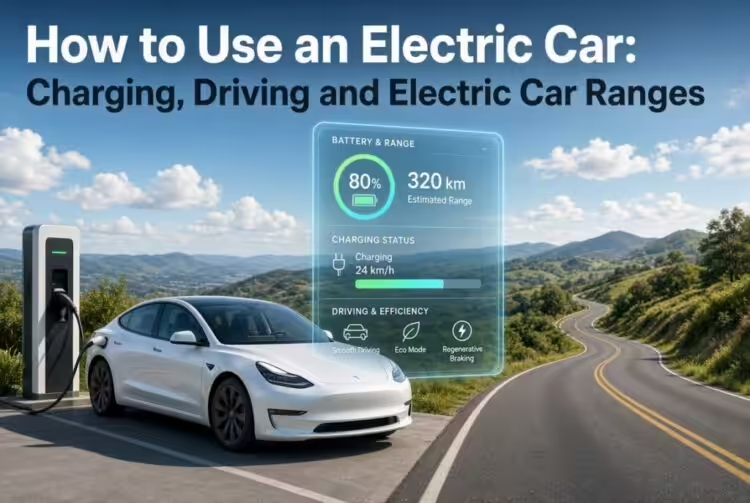
Electric cars are becoming increasingly popular around the world specially in USA, Europe, UK and China etc. because they offer quiet driving, instant acceleration, lower routine maintenance requirements, and the convenience of charging at home. However, if you have never driven an electric car before, you may have questions about charging, driving, battery life, and electric car range.
Unlike a conventional petrol or diesel vehicle, an electric car does not use an internal-combustion engine or a traditional gearbox. Instead, electricity stored in a high-voltage battery powers one or more electric motors.
This guide explains how to use an electric car, how to charge it, how to improve its range, and how the electric car range of different manufacturers compares.
What Is an Electric Car?
An electric car, often called an EV (electric vehicle), uses electricity stored in a rechargeable battery to power an electric motor.
When you press the accelerator, electrical energy is sent from the battery to the motor. The motor then turns the wheels. Electric cars generally provide instant torque, which means they can accelerate smoothly without the gear changes associated with many conventional vehicles.
Electric cars also use regenerative braking. When the vehicle slows down, the electric motor can recover some of the vehicle’s kinetic energy and convert it back into electrical energy for the battery. Kia explains that regenerative braking can recapture energy during deceleration and downhill driving.
How to Use an Electric Car
Using an electric car is relatively simple. The main difference is that you need to manage the battery’s state of charge rather than refueling with petrol or diesel.
1. Check the Battery Level
Before driving, check the battery percentage and the estimated remaining range shown on the dashboard.
For example, if your electric car shows:
- Battery: 80%
- Estimated range: 250 miles
- Destination: 100 miles away
you have a substantial amount of estimated range remaining. However, the displayed range is an estimate rather than a guarantee.
Weather, speed, traffic, hills, tire pressure, vehicle load, heating or air conditioning, driving style, and battery condition can all affect the actual distance you can travel.
2. Start the Electric Car
Most modern electric cars use a simple start procedure:
- Carry the key or have the key available.
- Sit in the driver’s seat.
- Press the brake pedal.
- Press the start/power button if your vehicle has one.
- Select D (Drive).
- Release the parking brake if required.
- Press the accelerator gently.
Many EVs are extremely quiet when switched on, so always check the dashboard and vehicle indicators before moving.
3. Accelerate Smoothly
Electric motors can produce high torque immediately. This means an electric car can accelerate very quickly even without a traditional transmission.
For normal driving, press the accelerator gradually rather than repeatedly accelerating hard. Smooth acceleration generally helps reduce energy consumption and can increase the practical electric car range.
4. Learn Regenerative Braking
One of the biggest differences when driving an electric car is regenerative braking.
When you release the accelerator or press the brake, the motor can work in reverse as a generator. Some of the energy is returned to the battery.
Depending on the vehicle, you may be able to adjust the regeneration level. Some EVs also offer one-pedal driving, where releasing the accelerator causes substantial deceleration.
However, regenerative braking does not eliminate the need to use the conventional brakes when necessary. Always drive according to road and traffic conditions.
How to Charge an Electric Car
Charging is one of the most important things to understand when owning an electric car.
There are three broad charging situations:
Level 1 or Slow AC Charging
This uses a standard household electrical connection in markets where the vehicle and electrical system support it.
It is generally slower than dedicated home charging, but it can be useful when the car is parked for a long period.
Level 2 AC Home Charging
A dedicated home charger can provide substantially more charging power than a basic household outlet.
This is particularly convenient for people who park at home because the car can charge overnight.
You can plug in after returning home and start the next day with a substantially higher battery level.
DC Fast Charging
DC fast chargers are designed for faster charging during longer journeys.
Charging speed depends on the vehicle, charger, battery temperature, battery state of charge, and other conditions.
Charging commonly slows as the battery approaches a high state of charge. Chevrolet, for example, notes that charging rates can reduce significantly around 80%, which is one reason drivers may spend less time at a fast charger by continuing their journey after an appropriate partial charge rather than always waiting for 100%.
Should You Charge an Electric Car to 100%?
You do not necessarily need to charge an electric car to 100% every time.
For everyday driving, many drivers use a lower target recommended by their vehicle manufacturer and charge to a higher level when preparing for a long trip.
The correct charging recommendation depends on the battery technology and vehicle manufacturer’s instructions, so always check your owner’s manual.
For a long journey, charging to a higher level can provide additional electric car range and reduce the number of charging stops. Detail is given below how to take time to charge electric vehicles:
| Electric car | Battery size | Home charging 0–100%* | DC fast charging |
| Lucid Air Grand Touring | 117 kWh | ~11–12 h** | Up to 300 kW; very fast charging, roughly ~20–30 min for a typical high-speed partial charge |
| Tesla Model S | ~100 kWh class | ~10–12 h** | Up to 250 kW; Tesla quotes substantial range added in 15 min |
| Mercedes-Benz EQS 450+ | ~108 kWh | 10 h at 11 kW / 5 h at 22 kW | Up to 200 kW, about 31 min at a fast charger |
| BMW iX xDrive60 | ~113 kWh | ~10 h 45 min at 11 kW | 10–80%: ~35 min |
| Hyundai IONIQ 5 | 63 or 84 kWh | 5 h 40 min (63 kWh) / 7 h 20 min (84 kWh) | 10–80%: 20 min with >250 kW/800V charging |
| Ford Mustang Mach-E | 73 / 88 kWh (some versions 91 kWh) | ~7.8 h standard battery / ~9.9 h extended battery | 10–80%: ~32 min standard battery |
| BYD SEAL | 82.5 kWh | ~8.6 h at 11 kW | 10–80%: ~37 min |
| BMW i7 eDrive50 | ~102 kWh class | ~11–11.5 h | 10–80%: ~34 min |
What Is Electric Car Range?
Electric car range is the estimated distance an electric vehicle can travel on a full battery charge under a specified testing procedure.
For example, a vehicle might have an EPA-estimated range of 300 miles or a WLTP-rated range of 500 kilometers.
These numbers should not automatically be compared as if they were identical measurements.
The EPA and WLTP testing procedures are different, and the same electric car can have different published range figures in different markets.
More importantly, real-world range can be different from the official laboratory estimate.
BMW specifically notes that its estimated EV range can vary because of factors including vehicle configuration, tires and wheels, driving style, traffic, temperature, accessories, and other conditions.
Electric Car Range From Different Companies
The electric vehicle market now includes manufacturers offering everything from compact city cars to luxury sedans and large SUVs.
Here are examples of published ranges from several manufacturers. These figures are provided as examples rather than a universal ranking because testing standards, trims and markets differ.
| Company | Example electric car | Published range |
| Lucid | Air Grand Touring | Up to 512 miles EPA/projected* |
| Tesla | Model S | Up to 410 miles EPA estimate |
| Mercedes-Benz | EQS | Up to 926 km WLTP |
| BMW | iX xDrive60 | Up to 364 miles EPA estimate |
| Hyundai | IONIQ 5 | Up to 318 miles EPA estimate |
| Ford | Mustang Mach-E | Up to 320 miles EPA estimate |
| BYD | SEAL | Up to 354 miles WLTP |
| BMW | i7 eDrive50 | Up to 314 miles EPA estimate |
*Range specifications can change by model year, trim, wheels and market. Always check the manufacturer’s current specification for the exact vehicle.
Lucid currently lists the Air Grand Touring at up to 512 miles of manufacturer-projected range for the applicable model configuration, while Tesla lists the Model S at up to 410 miles under EPA estimates.
Mercedes-Benz lists up to 926 km of WLTP electric range for the EQS 450+ in its current European specifications.
BMW’s U.S. specifications list the 2026 iX xDrive60 at 318–364 miles, depending on configuration.
Hyundai lists an EPA-estimated range of up to 318 miles for the 2026 IONIQ 5 in the specified RWD configuration.
Ford lists up to 320 miles of EPA-estimated range for the Mustang Mach-E with the appropriate configuration.
BYD’s 2026 SEAL specification lists up to 354 miles of WLTP combined range for the applicable version.
Why Electric Car Range Numbers Are Different
When comparing electric cars, do not look only at the largest number in a manufacturer’s advertisement.
Consider:
- EPA or WLTP testing standard
- Battery capacity
- Vehicle size and weight
- Wheel and tire configuration
- Rear-wheel drive or all-wheel drive
- Aerodynamics
- Temperature
- Highway versus city driving
- Driving style
- Heating and air conditioning
- Battery age and condition
A smaller, highly efficient electric car may travel a similar distance to a larger EV despite having a smaller battery.
Which Electric Cars Have Long Electric Car Ranges?
Long-range EV technology has developed significantly.
The Lucid Air is an example of a model focused heavily on efficiency and long-distance range. Lucid currently lists up to 512 miles of projected range for the Air Grand Touring under its specified configuration.
Tesla’s current Model S page lists up to 410 miles of EPA-estimated range, depending on configuration.
Other manufacturers are also offering EVs with ranges that can make long-distance driving practical.
However, the longest electric car range is not necessarily the most important factor for every driver. A vehicle with 300 miles of range and convenient charging may be more practical for one person than a vehicle with a larger battery but less convenient charging access.
How to Increase Your Electric Car Range
You can often improve your practical range by changing how you drive.
Drive at Moderate Speeds
Highway driving at very high speeds can significantly increase energy consumption because aerodynamic resistance rises as speed increases.
Driving at a steady, moderate speed can therefore help improve efficiency.
Avoid Unnecessary Hard Acceleration
Electric cars provide instant torque, so aggressive acceleration can consume energy quickly.
Smooth acceleration is generally more efficient.
Use Regenerative Braking
Use the regenerative-braking system appropriately where available. It can recover some energy during deceleration.
Maintain Correct Tire Pressure
Underinflated tires can increase rolling resistance and energy consumption.
Check tire pressure according to the vehicle manufacturer’s recommendations.
Reduce Unnecessary Weight
Carrying heavy items that you do not need can increase energy consumption.
Remove unnecessary cargo when practical.
Manage Heating and Air Conditioning
Climate control consumes electricity from the battery.
In very hot or cold weather, energy used for heating or cooling can reduce the available range.
Electric Car Range in Hot and Cold Weather
Temperature is an important factor in EV performance.
Extreme heat can increase the energy required for cooling, while cold temperatures can affect battery performance and cabin heating requirements.
This means the same electric car may show a different practical range in winter, summer, city traffic, and highway driving.
For this reason, it is better to think of the manufacturer’s range figure as a standardized comparison figure, not a promise that the car will always travel exactly that distance.
How to Plan a Long Trip in an Electric Car
Long-distance EV travel becomes easier when you plan your charging stops before starting the journey.
A simple process is:
- Fully charge the vehicle when practical.
- Enter your destination into the car’s navigation system.
- Check the expected battery level at arrival.
- Identify suitable charging locations.
- Plan a backup charging location where practical.
- Consider weather and traffic conditions.
- Avoid arriving at a remote charger with an extremely low battery level.
- Check whether the charging station supports your vehicle’s connector and charging requirements.
Many modern electric cars can automatically calculate charging stops as part of route planning.
Is an Electric Car Difficult to Drive?
For most drivers, an electric car is not difficult to operate.
In many ways, driving is simpler because there is no traditional multi-speed gearbox and no need to visit a petrol station for routine refueling.
The main new habits are:
- Monitoring battery percentage
- Understanding estimated range
- Planning charging
- Learning regenerative braking
- Knowing where compatible chargers are located
Once these habits become familiar, using an electric car can become a straightforward part of everyday driving.
Electric Car Maintenance
Electric cars generally have fewer moving drivetrain components than conventional internal-combustion vehicles.
However, an EV still requires maintenance.
Depending on the model, this can include:
- Tires
- Brake components
- Brake fluid
- Cabin air filters
- Windshield washer fluid
- Suspension components
- Cooling systems
- Battery and electrical-system checks
- Software updates
Regenerative braking can reduce the use of conventional friction brakes, but brake components still need inspection and maintenance.
Always follow the manufacturer’s maintenance schedule.
Electric Car vs Petrol Car
An electric car and a petrol car have different ownership and operating characteristics.
An electric car can be particularly convenient for people who can charge at home or at work. A petrol car, on the other hand, can generally be refueled quickly at conventional fuel stations.
For EV buyers, the most important questions may include:
- How much do you drive each day?
- Can you charge at home?
- How frequently do you take long trips?
- What charging infrastructure is available in your area?
- What electric car range do you actually need?
- What are electricity and charging costs where you live?
- Which EV models are available in your country?
Final Thoughts
Learning how to use an electric car is easier than many first-time buyers expect. The biggest change is replacing the traditional fuel-stop routine with battery and charging management.
When choosing an EV, electric car range is important, but it should not be the only consideration. Charging speed, charging availability, efficiency, battery size, vehicle price, comfort, safety, reliability, and your daily driving requirements also matter.
Modern electric cars now offer a wide variety of ranges. Some long-range models can travel hundreds of miles on a charge, while many mainstream EVs provide enough range for ordinary daily driving.
The best way to evaluate an electric car is therefore to compare its official range with your actual driving needs and local charging options. Always check the latest specifications from the manufacturer because range figures and available models can change between model years and markets.
If you want to sell your old car: Click Here


